



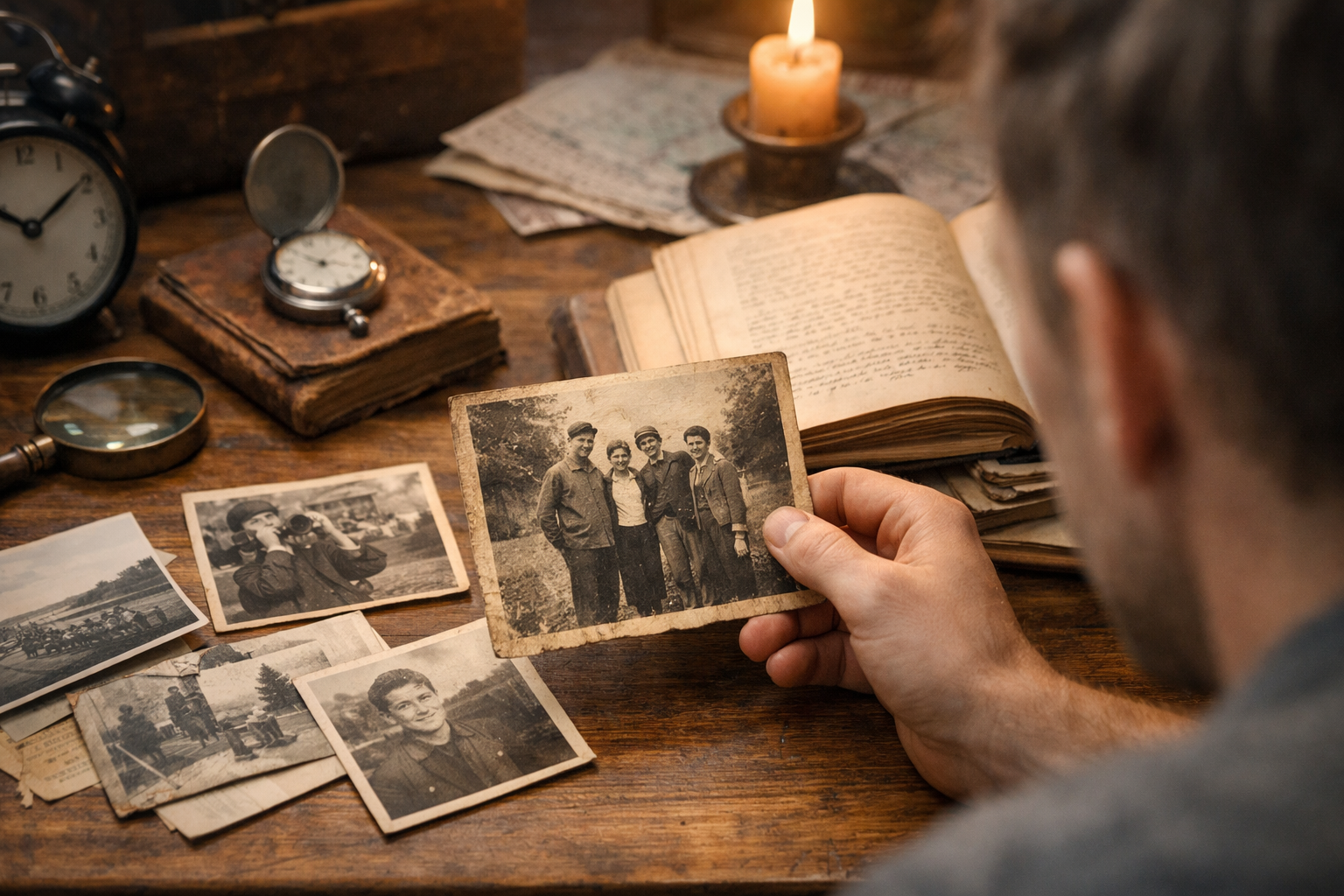
Why do we overvalue the past and distort our memories?
Why do we overvalue the past and distort our memories?
We often tend to believe that memory is a reliable repository where facts are carefully stored. We feel completely certain that we remember events—conversations, decisions, our own thoughts and emotions—exactly as they happened. However, research in the psychology of memory proves the opposite. Memory does not reproduce the past as it was; it reconstructs it anew each time.
The distortion of memories is not a rare error or a sign of poor memory. It is a fundamental feature of how the psyche functions. This feature helps us create a coherent picture of ourselves and the world, but at the same time it makes the past far less accurate than we might wish.
Memory is not an archive, but a process of reconstruction
One of the first researchers to show that memory is not a recording device but a process of reconstruction was the British psychologist Frederic Bartlett. In 1932, he published his work “Remembering.” Bartlett demonstrated that when people retell events, they unconsciously alter details in order to make the narrative more logical and more consistent with their expectations.
In his experiments, Bartlett asked participants to retell unfamiliar stories. With each retelling, the events became simpler, strange elements disappeared, and the story took on a more “reasonable” and coherent form. This showed that memory does not preserve information unchanged; instead, it adapts it to existing knowledge and beliefs.
Why does the past seem more logical over time?
One reason memories become distorted is the psyche’s drive for coherence and wholeness. A past filled with uncertainty and randomness is psychologically unstable. For this reason, the brain tries to construct a clear and consistent narrative out of events.
Once the outcome is known, memory reconstructs earlier events as if they had inevitably led to that outcome. Alternative possibilities and doubts fade away, and decisions that were once uncertain begin to appear more justified than they actually were at the time. As a result, the past seems logical and predictable—even when it was not.
The effect of new information: how the present “rewrites” the past
Information acquired after an event plays a crucial role in memory distortion. This mechanism was studied in detail by the American psychologist Elizabeth Loftus. In the 1970s and 1980s, she conducted a series of experiments showing that memories can be altered through the wording of questions and subsequent commentary.
In one classic experiment, participants were shown a video of a car accident and then asked questions using different verbs (for example, “collided” versus “smashed”). It turned out that the phrasing of the question directly influenced how participants remembered the speed of the cars and other details of the event. Some participants even “remembered” elements that were not present in the video at all.
These studies demonstrated that memory is highly suggestible and easily modified under the influence of new information.
Why do we overestimate our own memory?
Memory distortions are often accompanied by a strong sense of confidence. A person may be absolutely certain about the accuracy of their memories even when those memories are objectively incorrect. This happens because the accuracy of a memory and confidence in it are governed by different processes.
Psychological research shows that the more coherent and logical a memory feels, the more trustworthy it seems to the individual. In such cases, fact-checking fades into the background, and the subjective feeling of “I remember this clearly” is taken as proof of accuracy.
Memory distortions and self-evaluation
When reflecting on the past, people often adjust their memories to maintain a positive self-image. Mistakes appear less significant, successes seem more inevitable, and failures are explained by external factors.
On the other hand, in emotionally difficult states, memory can work in the opposite direction: past events begin to appear more negative than they actually were. Thus, memories reflect not only facts but also a person’s current psychological state.
Why memory distortions are not a “flaw”
It is important to emphasize that memory distortions are not a sign of poor memory or pathology. They are an adaptive mechanism that helps individuals integrate experiences, draw conclusions, and maintain a sense of continuity in their lives.
Problems arise not because distortions exist, but when a person treats memory as absolute truth and, on that basis, makes rigid and definitive judgments about themselves and others.
Conclusion
We tend to overestimate the accuracy of our memories and to see the past as more logical and predictable than it truly was. Memory does not record events; it continually reshapes them based on our knowledge, expectations, and current state.
Understanding this allows us to relate to our past more flexibly—not as a collection of unquestionable facts, but as a living experience that evolves along with us.